

Variable resistors – commonly known as adjustable resistors or electrical resistors – are essential components in electronic control. Whether it’s adjusting LED brightness, setting volume, or calibrating sensors, these components play a key role in dynamically controlling resistance in electrical circuits.
In this guide, we will explain what variable resistors are, their types, key features, and common functions, and help you find high-quality resistors and analog control components from DRex Electronics (your trusted global supplier of advanced electronic components).
🔍 What are variable resistors?
Variable resistors are components whose resistance value can be changed manually or electronically to regulate the current or signal level in electrical circuits.
They have at least two terminals, and in the case of a variable resistor, a third terminal (sliding contact) is available to adjust the output.
🛒 Do you need a variable resistor, a precision resistor, or a variable resistor?
👉 Buy variable resistors from DRex Electronics →
⚙️ Types of variable resistors
✅ 1. Variable resistor (Pot)
- Three terminals: two ends of the resistance path and a sliding contact point.
- Used for voltage division.
- Commonly used in volume and brightness controls and user interfaces.
✅ 2. Variable resistors
- Two ends: one fixed end and one sliding contact.
- Used for current regulation.
- Commonly used in motor controllers, lighting control devices, and heating devices.
✅ 3. Potentiometric resistors (Trimpot)
- Small, pre-calibrated variable resistors used for fine adjustment.
- They are typically used for calibration in manufacturing or for internal circuit adjustment.
📘 Related: Introduction to Potentiometric Resistors
🔧 Main characteristics of variable resistors
| Feature | Description |
|---|---|
| Resistance range | Varies (commonly 500Ω to 1MΩ) |
| Power rating | Ranges from 0.1W to several watts |
| Adjustment method | Rotational (knob), sliding, or via screwdriver (trimpot) |
| Tolerance | Typically ±10–20%, depending on type |
| Mounting options | Through-hole or surface-mount |
🛒 Looking for trimmer pots or rotary potentiometers?
👉 Find them at DRex Electronics →
🧪 How does a resistance measuring device work?
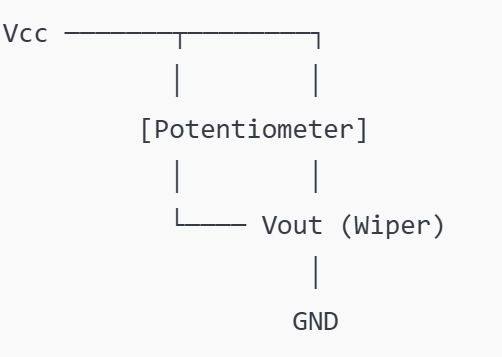
The sliding contact point moves along the resistance path and changes the output voltage (Vout) according to its position.
📘 Related: Understanding voltage divider circuits
💡 Applications of variable resistors
| Application | Use Case |
|---|---|
| Audio Systems | Volume, bass, and treble adjustment |
| Lighting Controls | Brightness dimmers and lamp tuning |
| Sensor Calibration | Adjusting sensitivity thresholds |
| Motor Speed Control | Regulating current to motors in fans or robotics |
| Instrumentation | Fine-tuning analog signal levels |
✅ Advantages of variable resistors
- Easy manual adjustment of signals or current
- Ideal for tuning and calibration
- Flexible use in analog and digital circuits
- Available in a wide range of shapes and resistance ranges
🛒 Looking for easy-to-use control components?
👉 Discover the user interface for variable resistors →
🏭 Industries That Use Variable Resistors
| Industry | Application Examples |
|---|---|
| Consumer Electronics | Audio equipment, game controllers |
| Industrial Automation | Sensor tuning, power supply calibration |
| Automotive | Dashboard dimming, HVAC controls |
| Medical Devices | Analog input adjustments |
| IoT & Embedded Systems | User interaction and field adjustments |
📘 Related: What Are the Differences Between Pull-Up and Pull-Down Resistors
✅ Summary
Variable resistors are simple and powerful tools for manual control, signal adjustment, and circuit calibration. By understanding their types and functions, you can use them effectively in a variety of applications, from audio equipment to automation systems.
⚡ Ready to integrate variable resistors into your next design?
Visit DRex Electronics today to purchase variable resistors, precision regulators, and resistor kits—all products come with expert support and fast worldwide delivery.